

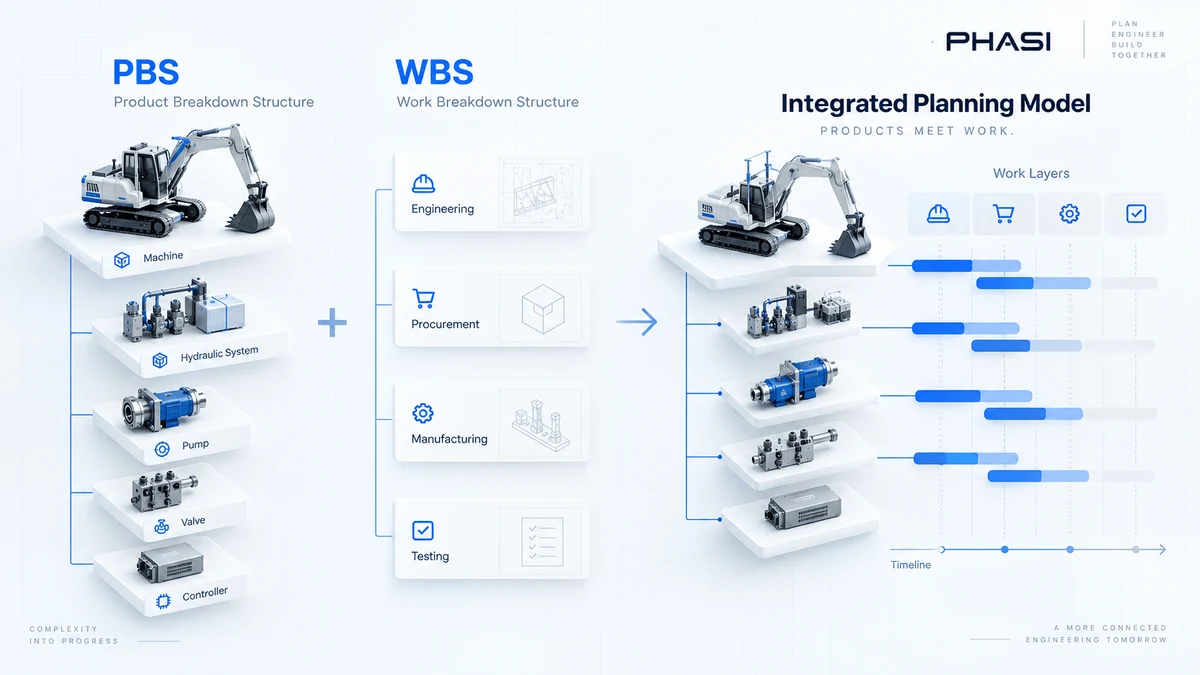
A project manager in custom machinery needs to answer two questions every day: What are we building? And what work still needs to be done to deliver it?
The Product Breakdown Structure (PBS) helps answer the first question. The Work Breakdown Structure (WBS) helps organize the second. They are related, but they do not describe exactly the same thing.
The distinction matters when one machine contains many assemblies, components and work activities, often running in parallel. This article explains PBS vs. WBS using an engineering example and shows how PHASI connects work phases directly to product elements.
What is a Product Breakdown Structure (PBS)?
A Product Breakdown Structure decomposes the product or set of deliverables into its constituent parts. It answers: What will the project produce or deliver?
A simplified PBS for a custom machine might be:
Custom Machine
├── Hydraulic System
│   ├── Pump
│   └── Valve
└── Control System
    └── Controller
This view makes product relationships easy to follow. The Pump is part of the Hydraulic System, and the Hydraulic System is part of the machine.
A PBS is a useful basis for reviewing deliverables, assemblies and interfaces. However, it does not by itself explain whether the Pump has been ordered, whether the Hydraulic System has been assembled or whether the Controller has completed its software testing.
The Association for Project Management (APM) distinguishes the PBS, which shows deliverables, from the WBS, which describes the work needed to produce them.
What is a Work Breakdown Structure (WBS)?
A Work Breakdown Structure decomposes the scope of work required to meet project objectives and deliver the outcomes. It helps define work packages and the extent of work for which the project is responsible.
A WBS is not necessarily a phase-by-phase schedule. Depending on the planning method, it may be organized around deliverables. The Project Management Institute (PMI) explicitly describes a WBS as a deliverable-oriented decomposition of project work. That is why a well-designed PBS and WBS can appear similar without becoming interchangeable.
For a practical comparison, consider a phase-oriented organization of work:
Machine Project
├── Engineering
│   ├── Pump
│   └── Controller
├── Procurement
│   ├── Pump
│   ├── Valve
│   └── Controller
├── Software
│   └── Controller
└── Testing
    ├── Pump
    ├── Valve
    └── Controller
This is one way to organize engineering activities—not a definition of every WBS. It helps people review all Procurement or Testing work together. But the complete set of work associated with one component is now spread across different branches.
PBS vs. WBS: the key differences
| Question | PBS | WBS |
|---|---|---|
| Primary perspective | What product or deliverables are being created? | What project work must be performed? |
| Typical hierarchy | Machine → System → Assembly → Component | Deliverables, work packages or, in a phase-oriented example, work categories |
| The Pump appears as | A component within the Hydraulic System | A product reference within several work packages or activities |
| What it does not show by itself | Complete execution status and schedule | In the phase-oriented example, work for one product element is spread across branches |
PBS and WBS are complementary. One describes the deliverable structure, the other helps structure the scope of work. A schedule adds the time dimension. Actual project control needs those dimensions to remain connected.
A machinery example: product-first vs. phase-first task planning
Assume our Pump requires Engineering, Procurement and Testing. The Valve requires Procurement and Testing. The Controller also requires Software work.
Two planning layouts are possible.
Approach A: place work tasks under product elements
Hydraulic System
├── Pump
│   ├── Engineering
│   ├── Procurement
│   └── Testing
└── Valve
    ├── Procurement
    └── Testing
The advantage is immediate: anyone reviewing the Pump can see its work in one place. The trade-off appears when a procurement manager wants to review all purchasing activity for the entire machine. The work is distributed across product branches, so another view or grouping may be needed.
Approach B: place work tasks under phase categories
Procurement
├── Pump
├── Valve
└── Controller
Testing
├── Pump
├── Valve
└── Controller
Here, work within a discipline is easy to review. The trade-off is that tasks concerning the same Pump are in separate branches. There are not multiple physical Pumps; there are multiple activities referring to the same product element. The team needs a way to bring those activities back into the Pump’s context.
Many planning systems support custom fields, classification codes and grouped views. The distinction is not whether an additional perspective is theoretically possible. It is how naturally a project team can plan and update work without mentally rebuilding the relationship to the product.
PHASI: product structure as the backbone, work phases as layers
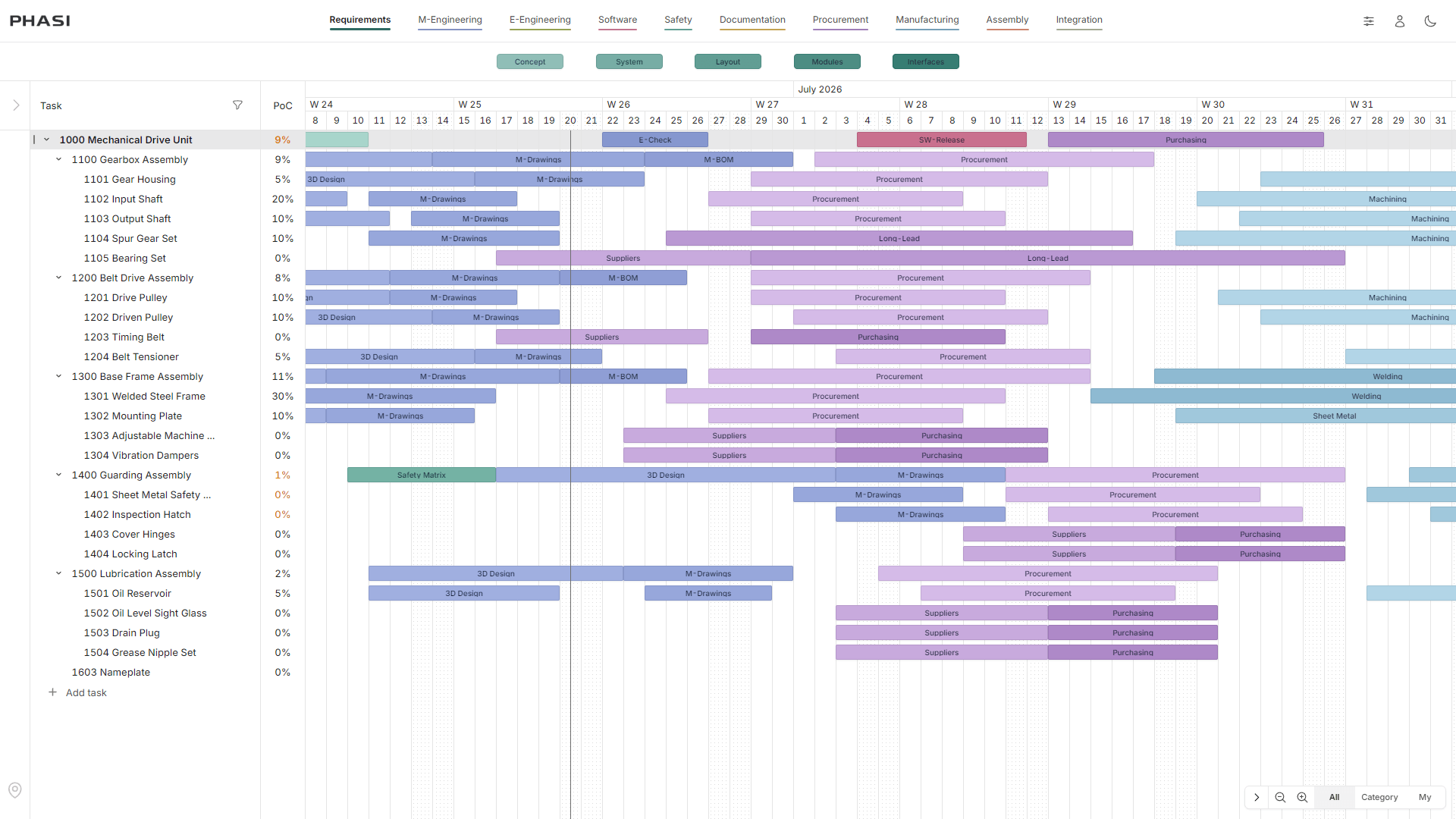
PHASI starts from a product-oriented hierarchy and associates relevant work phases with its components and assemblies.
Conceptually, the same machine can be represented as follows:
| PBS item | Engineering | Procurement | Software | Testing |
|---|---|---|---|---|
| Pump | ✓ | ✓ | – | ✓ |
| Valve | – | ✓ | – | ✓ |
| Controller | ✓ | ✓ | ✓ | ✓ |
The check marks mean that a phase is assigned to the item—not that the phase has been completed.
PHASI’s actual model goes beyond this table. Each assigned work phase has a place on the shared timeline. The Pump retains its position within the Hydraulic System. The Valve does not need irrelevant phases. The Hydraulic System itself can also have its own Assembly or Manufacturing phase, alongside work on its children.
This is what PBS with WBS work layers means in the PHASI context. Work is associated with the product structure instead of requiring a second, separately maintained product tree.
The PHASI features page shows the planning interface and its phase bars. The Engineering-to-Order methodology article describes the underlying approach in more detail.
Two ways to inspect the same plan
The model supports two useful project-review questions:
From product to work: Review the Pump’s work phases. Which relevant phases are complete, open or planned? How do they relate to the Pump’s parent assembly?
From work to product: Review Procurement activity. Which components require procurement work, and how does each sit within the machine?
The goal is not to pretend that product and work are the same structure. It is to preserve their relationship so the team can navigate the project without losing context.
Why the timeline matters
Neither a product tree nor a decomposition of scope is, by itself, a timeline. Engineering-to-Order projects require dates and planned time windows because several disciplines often work at once.
For example, the Pump’s Engineering phase might be complete while Procurement is open and Testing remains planned. The status is most useful when the team can see which product element it belongs to, which dates apply and what is happening at the surrounding assembly level.
This provides context for a project review. It does not automatically predict the project’s finish date or identify every critical dependency. Those conclusions require appropriate schedule logic and project judgment.
How calculated completion fits into the picture
PHASI connects phase status with Calculated Percent of Completion (PoC). According to the published methodology, completed relevant phase bars contribute through configurable category weights to each item’s completion. Those values roll up through the product hierarchy.
This is a model-based indicator, not a substitute for financial Earned Value calculations, documented acceptance or a physical inspection. Its interpretation depends on how the team defines and maintains the planning model.
Read the published PHASI completion rules to understand the calculation and aggregation logic.
When is a connected PBS/WBS approach useful?
The need becomes especially visible when:
- A machine has many assemblies with different work requirements.
- Purchased and engineered components follow different paths.
- Engineering, Procurement, Manufacturing and Testing overlap.
- Assembly-level work must coexist with component-level work.
- Teams repeatedly reconcile schedules, BOM data and status messages.
- Managers need to understand progress at both component and overall-machine level.
That does not mean every bolt must become a project item. The useful level of detail depends on what the team needs to plan, assign and review separately.
Frequently asked questions
Is every WBS organized by phase?
No. A WBS can be deliverable-oriented and decomposed into work packages. Phase-first planning is one practical layout used in the comparison above, not a universal definition of WBS.
Can PBS replace WBS?
No. PBS and WBS answer related but different questions. The PBS shows the product or deliverable structure; the WBS structures the scope of work required to deliver it.
Does PHASI use two independent trees?
That would be a misleading description of the PHASI planning concept. PHASI keeps a central product structure and assigns relevant work phases to its items on a shared timeline.
Conclusion: the connection matters more than the labels
For engineering teams, PBS vs. WBS is not a choice between two mutually exclusive planning methods. The key is to make product structure and work execution usable in the same operational context.
PHASI approaches this with one product hierarchy, relevant work layers, a shared timeline and calculated completion.
For a hands-on application, read Custom Machinery Project Planning: From Assemblies to Work Phases.
Want to see the model on a machine project? Request a PHASI demo.