

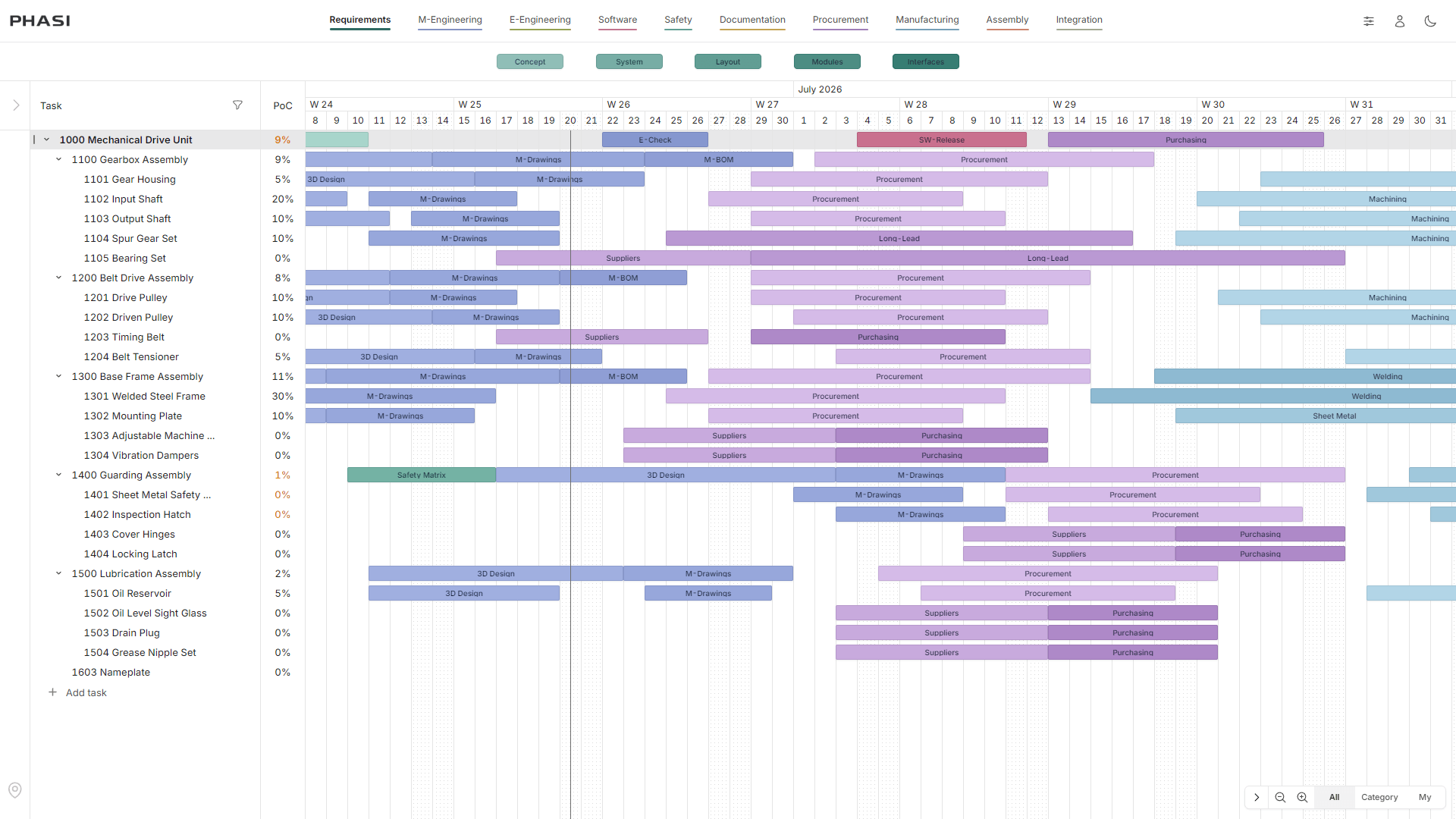
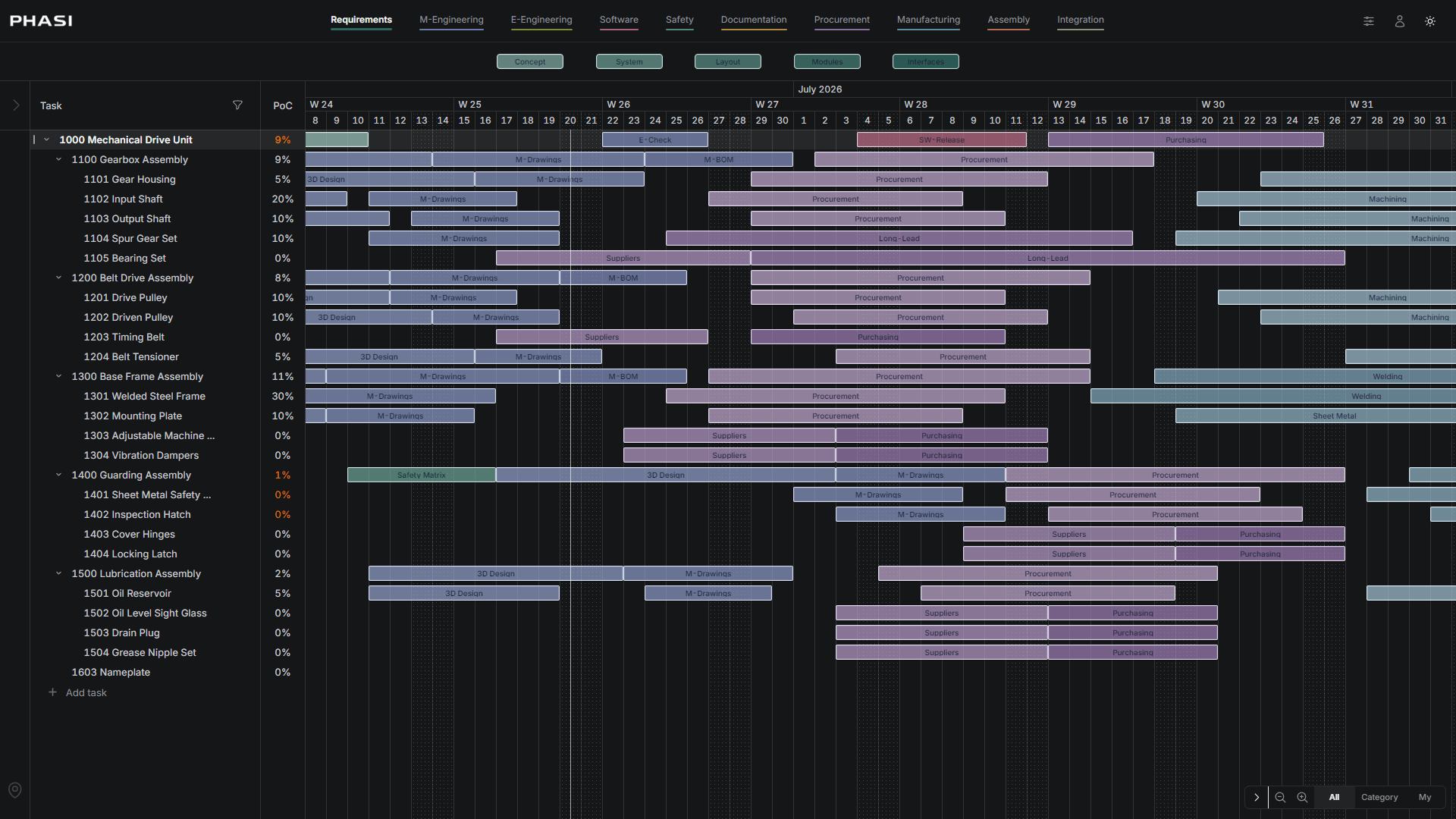
Engineering-to-Order projects are characterized by a high degree of engineering uncertainty. Unlike serial production, where the product, manufacturing route, and sequence of operations are usually stabilized in advance, ETO projects are built around a unique customer order: a machine, a production line, a technical module, an installation, an industrial system, or a complex set of products.
In such projects, engineering, procurement, manufacturing, assembly, and installation often run in parallel. A part may be changed after it has already been released to procurement. A supplier may shift a delivery date. Manufacturing may be waiting for an updated drawing. Installation teams may be planning work without having a complete view of assembly readiness. At the same time, the project manager is forced to reconstruct the real state of the project from multiple sources: ERP, PLM/PDM, CAD, Excel, calendars, meetings, and personal messages.
As a result, one of the key project indicators — Percent of Completion, or the project completion percentage — remains, in many engineering companies, not a calculated metric but an expert-based and subjective estimate. It is often formed around phrases such as “roughly done,” “almost finished,” “around 60%,” “procurement is mostly complete,” or “engineering is nearly finished.” For management accounting, resource planning, schedule control, and early identification of budget risks, this approach is not sufficient.
PHASI proposes a different methodology: calculating the readiness of an Engineering-to-Order project not top-down and not based on subjective task status, but bottom-up — from the actual state of work assigned to specific parts, units, assemblies, and deliverables.
This methodology can be defined as structural-phase management of ETO project readiness.
The Root Problem: The Gap Between What Is Being Created and What Work Is Being Performed
In engineering project management, two fundamental logics have long existed.
Product Breakdown Structure, PBS, answers the question: What must be created?
It defines the product structure: machine, system, module, unit, Baugruppe, assembly, part, purchased component, or deliverable.
Work Breakdown Structure, WBS, answers the question: What work must be performed?
It defines the work structure: engineering, review, procurement, manufacturing, assembly, integration, testing, installation, and acceptance.
Both logics are well known in project controls, construction, engineering, and complex technical projects. In practice, however, they often exist separately.
ERP and PLM/PDM systems work well with parts, BOMs, master data, revisions, purchase orders, and delivery dates. Gantt tools show schedules and dependencies. Jira, Monday, and similar systems manage tasks and workflows. Excel remains a flexible tool for manual control. Enterprise project controls systems support complex models of structure, scope, and schedule, but they are often too heavy for rapid implementation in mid-sized engineering teams.
The main gap remains: the product structure and the work structure are rarely connected in a simple, daily, calculated management loop.
Because of this, the project manager sees tasks but does not always see the real readiness of the product. They may see the BOM, but not which work phases have actually been completed for each critical part. They may see the schedule, but not understand which delays in engineering or procurement are already affecting assembly. They may see a completion percentage, but not know exactly how it was calculated.
PHASI closes this gap.
The Core of the PHASI Methodology
The PHASI methodology is based on a simple principle:
Project readiness must be calculated from the readiness of its product structure, and the readiness of each element of the product structure must be determined through the work phases that have actually been completed.
In other words, the project is considered not only as a set of tasks and not only as a schedule. It is considered as a connected model:
Product Structure + Work Phases + Timeline State = Calculated Project ReadinessIn this model, each product element — a part, unit, assembly, module, or deliverable — receives only those work phases that actually apply to it. For example:
- Requirements
- Engineering
- Design Review
- Procurement
- Manufacturing
- Assembly
- Integration
- Testing
- Installation
- Acceptance
Weights can be assigned to each phase category. Phases are planned on the timeline as phase bars. When specific phase bars are completed, the system recalculates the readiness of the element. The readiness is then rolled up through the structure: from part to unit, from unit to assembly, and from assembly to project.
In this way, Percent of Completion is no longer an opinion. It becomes the result of a calculation model.
Why Ordinary Task Management Does Not Solve This Problem
At first glance, it may seem sufficient to manage tasks: “design the part,” “order the component,” “manufacture the plate,” “assemble the module.” In ETO projects, however, the problem goes deeper.
A task by itself does not show which part of the product structure it covers. It does not always explain which unit a delay belongs to. It does not show how a change to a specific part affects procurement, production, assembly, and the final PoC. A task may be closed in the task tracker, while the product element itself is still not ready for the next stage.
The PHASI methodology changes the unit of management.
Instead of managing only a list of tasks, the team manages the readiness of product elements. Work becomes phases assigned to specific parts and units. This makes the connection between the engineering structure and project readiness explicit.
For Engineering-to-Order, this is fundamentally important because the product structure is the carrier of risk. It is not an abstract task that is delayed, but a specific part. It is not a general plan that changes, but a specific unit. It is not the entire assembly process that is blocked at once, but a particular assembly that depends on specific components and completed phases.
Core Principles of the Structural-Phase Methodology
1. The Product Structure Is the Basis of Management
The project does not begin with an abstract task list, but with the structure of what must be delivered to the customer. This may be a machine, a production line, a process module, a set of assemblies, or another hierarchy of deliverables.
The structure does not have to be complete on the first day. In real ETO projects, it evolves as requirements are clarified, engineering progresses, and the solution is decomposed. The PHASI methodology accounts for this reality: new Baugruppen, assemblies, parts, and deliverables can be added as the project develops.
2. Work Is Assigned Only to the Elements to Which It Actually Belongs
Not every part goes through the same set of phases. One component may require engineering, procurement, and machining. Another may be a purchased item and not require a manufacturing phase. A third may require a design review but not a separate procurement phase. A fourth may relate to installation or integration.
For this reason, PHASI does not apply a universal readiness template to all elements. Phases are assigned from reusable phase categories only where they are actually needed. If a phase does not apply to an element, it is not added and does not reduce that element’s readiness percentage.
This protects the calculation from a common error: when an element appears “not fully ready” only because irrelevant stages have been artificially applied to it.
3. Readiness Is Calculated Based on Completed Phase Bars
The methodology uses phase bars on the timeline. Each phase bar represents a specific work activity, or part of a work activity, assigned to a specific element of the product structure.
The calculation follows this principle:
Category contribution = category weight x completed phase bars / assigned phase barsIf a part has four engineering bars, one procurement bar, and three manufacturing bars assigned to it, readiness is calculated from the actually completed bars in each category.
For example:
- Engineering: weight 20%, completed 2 of 4 bars -> contribution 10%
- Procurement: weight 20%, completed 1 of 1 bar -> contribution 20%
- Manufacturing: weight 30%, completed 1 of 3 bars -> contribution 10%
The total readiness of the part across these categories is therefore 40%.
This calculation is transparent: every project participant can see exactly which phases form the current Percent of Completion.
4. Readiness Is Rolled Up Bottom-Up
An ETO project should not be assessed only at the top level. If a project consists of assemblies, assemblies consist of units, and units consist of parts, then the readiness calculation must follow this structure.
PHASI uses roll-up logic:
part PoC -> assembly PoC -> project PoCThis makes it possible to see not only the overall project percentage, but also the specific areas where readiness is lagging. A project may look “generally fine,” while one critical assembly is blocking installation. The structural-phase model makes such risks visible earlier.
5. Milestones Show Schedule Risk but Do Not Replace the Readiness Calculation
Milestones are important for understanding deadlines, control points, and schedule risk. However, they should not automatically replace the calculation of actual readiness.
In PHASI, milestones provide context: where the team should be according to the schedule, which dates are critical, and which activities are approaching a deadline. But Percent of Completion itself is not formed from milestone status; it is formed from the completion of assigned phases within the product structure.
This separates two different management questions:
- How ready is the product in reality?
- Does this readiness fit the required schedule?
How the Methodology Works in Daily Project Management
The practical application of PHASI can be described as a sequence of management actions.
First, the team creates the project structure: main deliverables, assemblies, Baugruppen, parts, modules, or other elements. Then the relevant work phases are assigned to these elements: engineering, procurement, manufacturing, assembly, integration, and others. After that, the phases are placed on the timeline and receive owners, deadlines, and execution status.
As work progresses, teams update the state of the phase bars. Completed phases automatically affect the readiness of the element. The readiness of the element affects the readiness of the parent node. The readiness of the nodes forms the readiness of the entire project.
This approach creates a single operational management loop for multiple stakeholders:
- Engineering sees which elements still require design, review, or change.
- Procurement understands which parts are critical for subsequent phases and where supplier delays create risk.
- Manufacturing sees which elements are ready for production and which still depend on engineering changes.
- Assembly and installation receive earlier signals about missing or modified parts.
- Project management receives a calculated view of readiness instead of a manually reconstructed status.
Management Value: Early Signal Instead of Late Explanation
The main value of PHASI is not that the system displays an attractive percentage. The value lies in the fact that this percentage becomes an early management signal.
In many engineering companies, problems become visible too late. The supplier has already delayed the part. Assembly is already waiting for a component. An engineering change has already affected production. The budget has already begun to exceed its limits. The project manager learns about it only after a series of clarifications, meetings, and manual reconciliations.
The structural-phase methodology moves the point of risk detection earlier.
If a procurement phase is delayed for a critical part, this is visible at the level of that part and the related assembly. If an engineering phase is not closed while manufacturing should already be starting, a clear schedule risk emerges. If assembly is waiting for a unit whose calculated readiness is below the required level, the problem becomes visible before work actually stops.
This makes it possible to manage causes rather than consequences.
How PHASI Differs from ERP, PLM, Primavera, and Excel
PHASI does not replace ERP, PLM, PDM, CAD, or enterprise project controls.
ERP remains the system for orders, deliveries, finance, inventory, and master data. PLM/PDM remains the source of engineering data, revisions, BOMs, and change management. CAD remains the engineering design environment. Primavera and similar enterprise systems remain powerful tools for complex project controls at the level of large organizations.
PHASI occupies a different layer.
It is a focused planning layer for Engineering-to-Order teams that need a lightweight and understandable way to connect product structure, phase-based work, timeline, and calculated readiness.
Compared with Excel, PHASI provides a live structure connected to phases and roll-up calculation. Compared with a conventional Gantt tool, it provides the assignment of work to parts and assemblies. Compared with a task tracker, it provides a product-oriented readiness model. Compared with enterprise systems, it provides a lighter SaaS implementation for teams that do not need a full, heavy project controls environment.
Why This Is a New Methodology Specifically for Engineering-to-Order
Classic PBS and WBS are not new in themselves. The novelty of PHASI does not lie in reinventing the product structure or the work structure.
The novelty lies in methodically combining these approaches into a daily calculation model for ETO projects:
- Each product element receives its own set of relevant phases.
- Each phase has a timeline position and a status.
- Readiness is calculated from completed phases.
- The result is aggregated through the product hierarchy.
This makes the methodology especially applicable to projects where:
- The product is created for a specific customer order.
- The product structure develops during execution.
- Engineering, procurement, manufacturing, and assembly run in parallel.
- Design changes occur after the project has started.
- Suppliers affect the readiness of assemblies.
- Installation depends on the actual availability of parts.
- Manual status control takes significant time.
- Percent of Completion is important for management and financial decisions.
In such conditions, an ordinary task completion percentage is not sufficient. What is needed is a readiness indicator connected to the technical structure of the project.
PHASI as an Operational Model, Not Just a Dashboard
A dashboard displays data. The PHASI methodology forms data.
This is an important distinction.
If a system only collects information from ERP, PLM, or task trackers, it displays statuses that already exist. But if those statuses are not originally connected to the product structure and work phases, a dashboard does not solve the root problem.
PHASI defines how the project is managed: how to decompose the structure, how to assign phases, how to calculate readiness, how to roll up PoC through the hierarchy, and how to connect the timeline with engineering reality.
For this reason, PHASI should not be considered a visual add-on, but a methodology for managing the readiness of ETO projects, implemented in a SaaS product.
Conclusion
Engineering-to-Order projects require a different approach to readiness management. It is not enough to know which tasks are open and which dates are shown in the schedule. It is necessary to understand which product elements are actually ready, which phases have been completed for them, and which delays are already affecting assembly, delivery, and budget.
PHASI offers a structural-phase methodology in which the product hierarchy is connected with work phases and the timeline, while Percent of Completion is calculated bottom-up — from part to assembly and from assembly to project.
This approach makes project readiness more transparent, reduces dependence on subjective estimates, decreases the manual effort required to collect status information, and gives the project manager an earlier signal of risks.
For Engineering-to-Order companies, this means moving from management through assumptions and meetings to management through a calculated model of actual readiness.
Percent of Completion is no longer an approximate opinion.
It becomes a project management instrument.